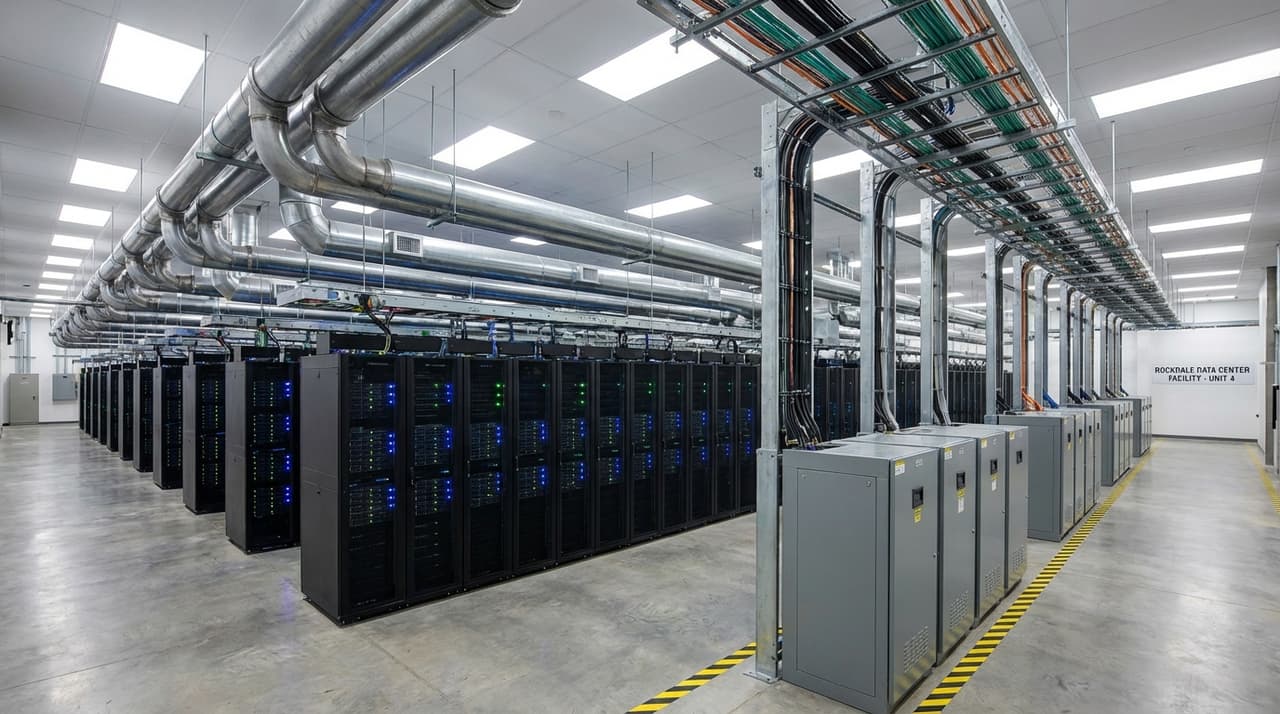
- Riot Platforms (RIOT) secures a 10-year data center lease with AMD (AMD), projecting initial revenue of $311 million and potential expansion to $1 billion.
- The deal is funded by a $96 million land acquisition at its Rockdale, Texas site, financed through the sale of 1,080 Bitcoin.
- This move diversifies Riot's revenue away from volatile Bitcoin mining, tapping into surging AI-driven demand for high-performance computing.
A Strategic Pivot Gains Momentum
Riot Platforms (NASDAQ: RIOT) saw its stock rise 5% on January 16, 2026, after announcing a significant data center lease agreement with AMD, marking a pivotal step in its shift from Bitcoin mining to infrastructure for artificial intelligence and hyperscale computing. The deal, which includes an initial 25 megawatts of capacity expandable to 200 MW, is expected to generate $311 million in revenue initially, with extensions potentially boosting that to $1 billion over the decade, according to company filings. This comes as Riot leverages its approximately 1.7 gigawatts of fully approved power capacity across Texas sites, including Rockdale and Corsicana, positioning it to capitalize on the booming AI sector.
Efforts to restructure its business model have accelerated in recent months, with Riot selling Bitcoin worth $161 million in December 2025 to fund this transition and opening a $500 million at-the-market equity offering for capital expenditures. The AMD lease involves retrofitting existing infrastructure with $89.8 million in capex, aiming to deliver the initial 25 MW in phases from January to May 2026. Without such deals, the company would risk underutilizing its vast power portfolio, a concern echoed by analysts who emphasize the need for quick, high-quality leases to avoid idle capacity.
Industry Trends and Execution Risks
Riot's pivot mirrors a broader trend among Bitcoin miners, such as TeraWulf (WULF), Cipher Mining (CIFR), and IREN (IREN), which are repurposing their energy assets for AI data centers to diversify from the volatility of cryptocurrency revenues. In Texas, a leading U.S. data center market, Riot's expansion benefits from the state's robust power grid, which supports its 1.7 GW capacity without significant regulatory hurdles, according to people familiar with the matter. The company has also narrowed its 2026 executive incentives to focus solely on data center milestones like infrastructure development and leasing, signaling a sharp strategic focus.
Hasmukh Ranjan, AMD's chief information officer, highlighted the partnership's role in scaling AI infrastructure faster, stating that it aligns with growing demand for high-performance computing. Meanwhile, Riot promoted an insider to CFO amid this push and shifted from monthly Bitcoin production reports to quarterly business updates centered on data centers, reflecting its evolving priorities. The deal is projected to create jobs in the local Texas economy through retrofits and expansions, though no public reactions or debates have been reported yet.
Short-term risks include execution challenges in retrofitting assets and achieving expected returns on capex, but long-term prospects look promising with potential expansions to 200 MW for AMD and filling 700 MW at Rockdale for other hyperscale tenants. As of the announcement, Riot's stock performance underscores investor optimism, but analysts caution that success hinges on securing additional leases promptly to maximize its power capacity.
Correction: An earlier version misstated the equity offering amount; it is $500 million, not $600.53 million.